Blog Detail
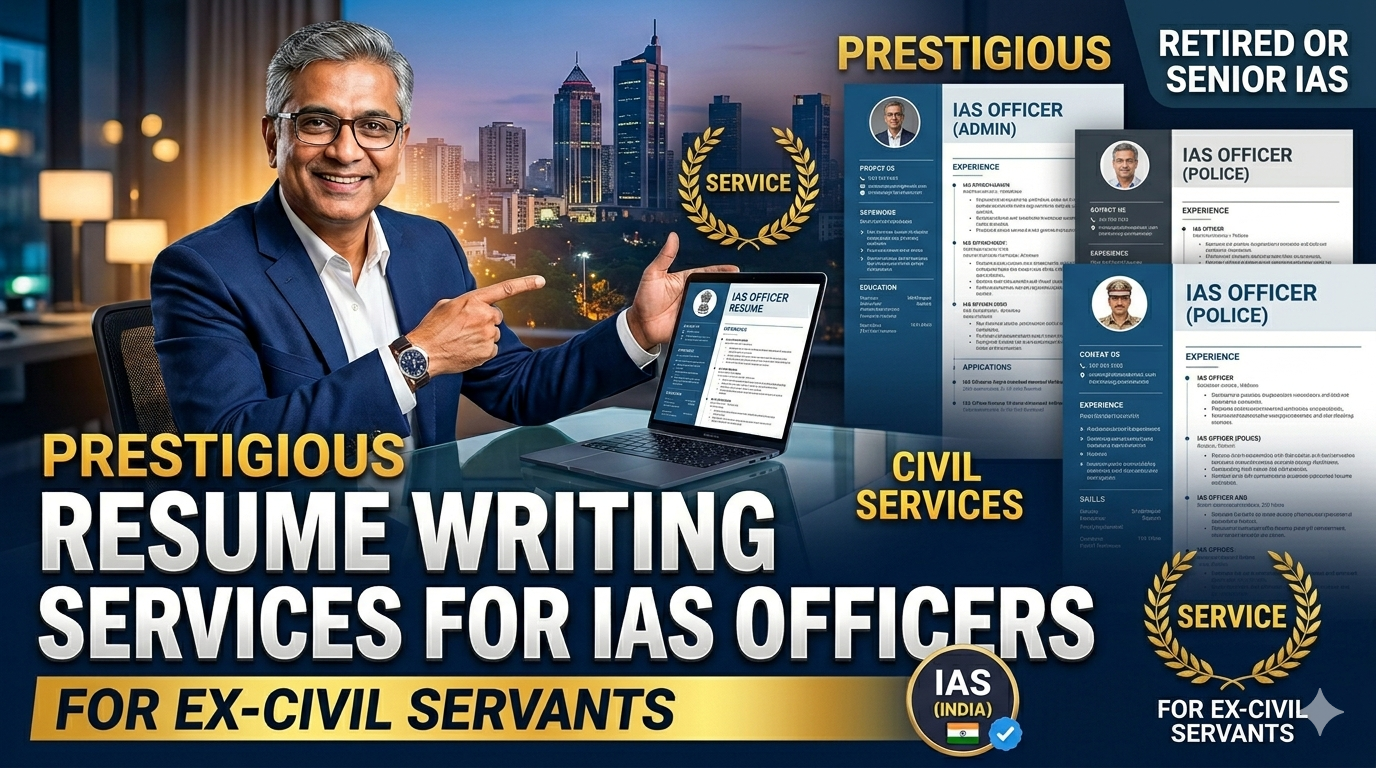
Resume Writing Services for IAS Officer
May 21, 2026
Why IAS Officers Need a Specialist Resume Writer for Private Sector Transition in 2026
You have administered districts. You have shaped policy that affected millions. You have managed ₹500 crore budgets, led teams of thousands, and navigated the most complex institutional machinery in the world.
And yet, when it comes to writing a resume for the private sector, most IAS officers struggle to translate that extraordinary experience into language that corporate India understands and values.
This is not a failure of achievement. It is a failure of translation — and it is precisely where a specialist resume writer makes the difference between a CV that gets filed and one that earns a call.
At resumewritingservices.in, we have helped IAS officers, IPS officers, IFS officers, and senior civil servants at every stage of transition — from voluntary retirement to mid-career lateral moves — build private sector resumes that communicate real impact in corporate terms.
This guide explains everything you need to know before making that transition, and why the way your resume is written will determine whether India Inc. sees your government career as an asset or an anomaly.
The Growing Wave of IAS Officers Moving to the Private Sector
The movement of IAS officers toward the private sector is not new, but its pace and profile have changed significantly. Officers are now leaving service at all stages — mid-career through Voluntary Retirement Scheme (VRS), after completing partial pensionary benefits, and post-retirement into corporate and advisory roles.
According to data furnished in the Indian Parliament, over 850 IAS, IPS, and IFS officers resigned or took voluntary retirement in a 15-year period, with the trend accelerating post-2019. The reasons are consistent: the desire for financial upside, frustration with bureaucratic constraints, entrepreneurial ambition, and the desire to apply governance expertise in a faster-moving environment.
The private sector roles that IAS officers typically target include:
- Government Affairs and Public Policy leadership at multinational corporations and large Indian conglomerates
- Independent Director and Board Advisory roles, where governance experience commands premium positioning
- Corporate Affairs, Regulatory, and Compliance leadership, especially in banking, infrastructure, energy, and telecom
- CSR and ESG leadership, where understanding of government frameworks and policy is a direct advantage
- Consulting and Advisory roles at management consulting firms, think tanks, and policy institutions
- Senior operations roles in public sector undertakings, regulatory bodies, and quasi-government institutions
The mandatory cooling-off period — during which a retired civil servant may not take up certain private sector positions directly connected to their last government role — has been reduced to one year in most cases. This makes the timing of your career transition planning, and therefore your resume preparation, more important than ever.
Why a Standard Resume Writer Cannot Write an IAS Officer's CV
Most resume writers are trained to work with corporate career profiles — sequential roles at companies, measurable KPIs, revenue targets, team hierarchies. An IAS officer's career does not fit any of those templates. And if a generalist tries to force it into one, the result is almost always a resume that either undersells the scale of government work or presents it in a way that corporate hiring managers find abstract and difficult to assess.
Here is what makes an IAS officer's career structurally different from a corporate career — and why specialist expertise matters:
1. Role Diversity Without a Linear Title Progression
An IAS officer might serve as District Collector, then move to a Finance Ministry role in Delhi, then head a state-owned enterprise, then serve as Municipal Commissioner, all within fifteen years. Each role is a different function, a different scale, and a different domain. A generalist resume writer will either flatten this into a confusing chronology or try to impose a false specialisation on it.
A specialist resume writer understands how to identify the through-line — the consistent leadership capabilities that connect wildly different postings — and build the resume narrative around that.
2. Achievement Language That Does Not Translate Automatically
In government, achievements are framed around policy outcomes, public service delivery, compliance, and administrative efficiency. In corporate environments, achievements are framed around revenue impact, cost reduction, team performance, and stakeholder value creation.
"Successfully implemented the PMGSY road connectivity scheme across 120 villages in the district" is a genuine achievement. But it needs to be translated into language that reads as business value: scale, timeline, budget managed, stakeholder complexity, outcome delivered. Without that translation, a corporate hiring manager may not immediately recognise the leadership capability being demonstrated.
3. The ATS Problem for Government Resumes
Many corporate roles — including board positions at large companies and leadership roles at MNCs — now use Applicant Tracking Systems (ATS) as a first filter. Government resume language is almost entirely incompatible with ATS keyword requirements out of the box.
A resume full of government terminology — cadre, deputation, IAS probationer, revenue divisional officer, panchayati raj — will not match the keyword profiles that ATS systems are built to screen for. A specialist executive resume writer knows how to restructure and reframe this language so that both the ATS and the human reader understand what they are looking at.
4. The Cooling-Off Period and Disclosure Sensitivity
IAS officers transitioning to the private sector must be careful about how they position their government roles relative to the companies or sectors they are targeting, particularly if a cooling-off restriction applies. A specialist resume writer understands this nuance and can frame your career story compliantly and strategically.
What a Private Sector Resume for an IAS Officer Must Include
A well-crafted IAS officer private sector resume is not simply a reformatted government service record. It is a strategic document that makes a specific argument: that your career in government has given you capabilities, relationships, and a track record of complex leadership that is directly valuable to a private sector organisation.
Here are the core elements it must contain:
Executive Summary / Leadership Positioning Statement
This is the most important section and the one most often written badly. Your summary must not describe what you did in government. It must declare what you bring to a corporate organisation — in corporate language.
Weak version: "Retired IAS officer of the 1995 batch with 28 years of experience in administration, policy, and public governance."
Strong version: "Senior public sector leader with 28 years of P&L responsibility, large-scale infrastructure programme management, and cross-functional stakeholder leadership across central and state government. Proven track record navigating complex regulatory environments, building high-performance teams, and delivering measurable outcomes at district, state, and national scale."
The difference is not honesty — both are accurate. The difference is translation. The second version speaks directly to what a corporate board or hiring committee is looking for.
Quantified Achievements Section
Every significant posting must be represented through specific, measurable outcomes. The format that works best is: Situation → Action → Quantified Result.
Examples of how this looks in practice:
- Managed ₹800 crore annual district development budget; achieved 97% utilisation rate against sector average of 71%, earning state government commendation for fiscal efficiency
- Led cross-departmental task force of 14 agencies to resolve 3-year infrastructure dispute; resulted in operationalisation of ₹1,200 crore industrial corridor project within 9 months
- Oversaw revenue collection improvement programme across 8 tehsils; increased compliance rate from 62% to 89% within 18 months through process redesign and field team restructuring
These are not fabrications — they are accurate descriptions of real government work, translated into the metric-driven, outcome-focused language that corporate hiring decisions are made on.
Core Competencies Section
ATS systems scan for keyword density in specific functional areas. Your core competencies section must be tailored to the type of roles you are targeting. For IAS officers moving into:
- Government Affairs roles: Regulatory frameworks, policy analysis, stakeholder management, government liaison, legislative affairs
- Board and Advisory roles: Governance, risk management, compliance, audit oversight, public accountability
- Operations and Infrastructure roles: Programme management, budget oversight, vendor management, public-private partnerships, capacity building
- Consulting roles: Policy design, institutional reform, public sector transformation, stakeholder engagement
Education and Credentials
IAS credentials carry significant weight, but must be presented strategically. Your UPSC rank, batch year, and cadre assignment signal intellectual calibre and institutional rigour to any Indian corporate hiring manager. Present them clearly and confidently. If you hold additional degrees — an MBA, a master's from a foreign university, or a specialised certification — list them in full, as they bridge the government-to-corporate credibility gap.
Board Affiliations, Advisory Roles, and External Engagements
Any board memberships held during your government career — chairing PSU boards, serving on regulatory committees, representing the government in international forums — are directly relevant to corporate India and must be listed explicitly.
The 6-Stage Process We Follow at resumewritingservices.in
When an IAS officer or senior civil servant engages resumewritingservices.in for a private sector career transition, we follow a structured process designed specifically for the complexity of government career profiles.
Stage 1: Career Audit and Target Role Mapping
We begin with a detailed intake process that covers your full service record, your target role types, your preferred industries, and your timeline. We also discuss any cooling-off period constraints and identify which aspects of your government career are most strategically relevant to position.
Stage 2: Achievement Mining and Quantification
This is the most intensive stage. We work with you to extract and quantify the most significant outcomes from each of your key postings. Most IAS officers have significantly more quantifiable achievements than they initially believe — they simply have not been trained to frame government work in output terms. We change that.
Stage 3: Narrative Architecture
We build the through-line of your career story — the consistent leadership identity that runs through district postings, ministry roles, PSU leadership, and policy work. This narrative becomes the backbone of your executive summary, your cover letter, and your LinkedIn profile.
Stage 4: ATS Optimisation and Keyword Integration
We align your resume language to the specific keyword profiles of your target roles. If you are targeting Government Affairs Director roles at MNCs, we know which keywords those ATS systems screen for. If you are targeting Independent Director positions, we know what governance-related terminology boards and nomination committees respond to.
Stage 5: LinkedIn Profile Optimisation
Your LinkedIn profile and your resume must tell the same story with the same authority. We update your LinkedIn headline, About section, and experience entries to match the positioning of your new resume and ensure maximum visibility to corporate search firms and executive headhunters who are actively seeking candidates with government leadership backgrounds.
Stage 6: Review, Refinement, and Delivery
You receive a fully formatted executive resume ready for immediate use, along with a tailored cover letter framework and a LinkedIn profile revision. We include two rounds of revisions to ensure the final document reflects both our expertise and your comfort with how your career is being represented.
Private Sector Roles Where IAS Officers Have a Distinct Advantage
Understanding which roles genuinely value your IAS background — rather than merely tolerating it — is critical to targeting your job search strategically.
Independent Director and Non-Executive Board Roles
SEBI's corporate governance regulations require listed companies to have independent directors with genuine expertise in governance, accountability, and institutional oversight. IAS officers bring exactly this combination. Many retired and voluntarily retired IAS officers now serve on the boards of listed companies, PSUs, banks, and financial institutions in India. This is one of the most natural and high-value transitions available.
Government Affairs and Regulatory Affairs Leadership
Any large corporation operating in regulated industries — banking, insurance, telecom, energy, infrastructure, pharmaceuticals — needs senior leaders who understand how government policy is made, how regulatory frameworks operate, and how to manage relationships with government stakeholders at state and central level. An IAS officer with relevant sectoral exposure is an extraordinarily valuable candidate for these roles.
Public Policy and Corporate Social Responsibility
CSR and ESG functions at large corporations increasingly require leaders who understand government policy frameworks, community development, and the mechanics of public-private partnerships. IAS officers who have led MNREGA implementation, smart city programmes, or district development initiatives have directly transferable expertise.
Management Consulting — Public Sector Practice
The major consulting firms — McKinsey, BCG, Deloitte, PwC, EY, KPMG — all have dedicated public sector and government advisory practices. An IAS officer who can advise private sector clients on navigating government processes, or advise government on institutional reform, is highly sought after at the Principal or Partner level.
Academic and Think Tank Leadership
IAS officers with strong domain expertise often find significant demand from policy research institutions, IIMs, IITs, and international development organisations. These roles value both the practitioner's perspective and the institutional credibility of civil service background.
Common Mistakes IAS Officers Make When Writing Their Own Resume
Mistake 1: Writing a Service Record, Not a Resume
A government service record lists postings, dates, and departments. A private sector resume must tell a story of decisions made, challenges solved, and outcomes delivered. These are fundamentally different documents, and treating one as a draft for the other produces a CV that impresses no one.
Mistake 2: Using Government Terminology Without Translation
Terms like "Collector", "SDM", "IAS probationer", "cadre posting", "deputation", and "panchayati raj" are meaningless to most corporate hiring managers outside India, and even within India, many private sector HR professionals have limited familiarity with government administrative hierarchies. Every government term that appears on your resume must either be translated into corporate language or accompanied by a brief contextual explanation.
Mistake 3: Omitting Scale and Budget Context
District Collectors manage budgets and populations that would represent significant P&L responsibility in any corporate context. A district with a population of two million and an annual development budget of ₹600 crore is, in operational terms, a mid-sized business. Most IAS officers do not make this comparison explicit on their resume. They should.
Mistake 4: Not Tailoring for the Target Role
An IAS officer targeting a Government Affairs Director role at a pharmaceutical company needs a very different resume from one targeting an Independent Director position at an infrastructure firm. The same career, the same achievements — but a completely different emphasis, different keywords, and a different executive summary. A single generic resume sent to all opportunities will underperform consistently.
Mistake 5: Ignoring LinkedIn Entirely
Many senior IAS officers have minimal or outdated LinkedIn profiles. Corporate India's executive search ecosystem runs almost entirely through LinkedIn. Spencer Stuart, Egon Zehnder, Korn Ferry India, and their Indian counterparts search LinkedIn daily for candidates with precisely the profile that senior IAS officers carry. If you are not findable and presentable there, you are invisible to the most active part of the executive hiring market.
Why resumewritingservices.in Is the Right Partner for Your Transition
We are not a generalist resume writing platform. We are specialists in executive career positioning, and our work with IAS officers and senior civil service professionals reflects a deep understanding of both the government career context and the corporate hiring environment.
Our service includes:
- Dedicated executive resume writing by specialists who understand IAS career structures, posting histories, and the language of government achievement
- ATS-optimised formatting that ensures your resume passes automated screening for corporate and board-level roles
- LinkedIn profile optimisation aligned to your new positioning so executive headhunters can find and shortlist you
- Cover letter writing tailored to the specific nature of private sector approaches from a government background
- Confidentiality — we understand that for serving officers considering VRS or those in their cooling-off period, discretion is essential
If you are an IAS officer, IPS officer, or senior civil servant at any stage of your transition — whether you are actively applying or simply beginning to think about what comes next — the right time to build your private sector resume is now, not after you have left service.
Contact resumewritingservices.in today to discuss your transition. Your government career is an extraordinary asset. Let us make sure your resume proves it.
Quick Reference: IAS Officer Private Sector Resume Checklist
| Element | What It Must Do |
|---|---|
| Executive Summary | Declare corporate value, not government history. Written for the hiring manager, not the UPSC |
| Achievements | Quantified outcomes: budget managed, scale led, timeline, % improvement |
| Core Competencies | Keywords matched to target role type — not generic government terms |
| Role Descriptions | Translate postings into corporate context: P&L scale, team size, stakeholder complexity |
| Education | UPSC rank, batch, cadre — plus any additional degrees or certifications |
| Board / Advisory | All PSU boards, regulatory committees, government bodies chaired or served |
| LinkedIn Profile | Consistent with resume; optimised for executive search visibility |
| ATS Compliance | Government terminology translated; ATS-safe formatting applied |
| Cover Letter | Addresses the government-to-corporate transition directly and confidently |
Frequently Asked Questions
Can an IAS officer take up a private sector job while still in service?
No. Serving IAS officers are bound by All India Services (Conduct) Rules and cannot take up private employment without government permission. The transition to private sector employment — whether through voluntary resignation or VRS — must comply with DOPT regulations, and a mandatory cooling-off period applies after leaving service. The cooling-off period, which restricts certain private sector roles directly related to your last government position, has been reduced to approximately one year in most cases. It is advisable to consult legal counsel on your specific situation before making any commitment to a private employer.
How should an IAS officer explain the cooling-off period to a private employer?
Directly and confidently. Most sophisticated corporate employers — MNCs, large Indian conglomerates, and governance-focused organisations — understand the cooling-off obligation and will structure a formal appointment date accordingly. Your resume and cover letter should acknowledge it matter-of-factly where relevant, treating it as a regulatory compliance matter rather than an obstacle. A well-written cover letter, which we draft as part of our service at resumewritingservices.in, handles this naturally.
What is the best private sector role to target as a retired IAS officer?
This depends on your sectoral specialisation, the ministries and departments you served in, and your personal interests. Officers with finance ministry experience often move into banking, financial services, or regulatory advisory. Officers with infrastructure or urban development backgrounds often transition into real estate, construction, or smart cities consulting. Officers with rural development or agriculture exposure often find demand in agri-tech, FMCG, and CSR leadership. The strongest transitions are those where your government domain expertise maps directly to a corporate need — and your resume must make that connection explicit.
How long should an IAS officer's private sector resume be?
For a senior IAS officer with 20 or more years of service, two pages is the appropriate length. Three pages is acceptable if board affiliations and significant external engagements warrant it. Anything longer risks losing the reader's attention. The discipline of compression — selecting only the most strategically relevant achievements from a long career — is one of the most valuable things a specialist resume writer brings to this process.
Does resumewritingservices.in maintain confidentiality for serving officers?
Yes. We treat all client engagements with complete confidentiality. We do not publish client names, share career information with third parties, or maintain visible records of clients in our public marketing. For serving officers who are exploring private sector options while still in government, discretion is a fundamental part of our service commitment.
How quickly can resumewritingservices.in deliver an IAS officer's executive resume?
Our standard turnaround for executive-level resume writing is four to five working days from the completion of your intake consultation. Expedited delivery is available for urgent situations. Given the complexity of a 20 to 30 year government career, we strongly recommend allowing the full standard timeline to ensure the quality of achievement mining, narrative development, and ATS optimisation that your profile deserves.
What does a resume writer for an IAS officer cost at resumewritingservices.in?
Our executive resume writing packages for senior civil service professionals are priced based on the seniority level and the scope of deliverables required — resume, LinkedIn, and cover letter. Contact us directly for a consultation and pricing specific to your career level and target role type. We offer a free initial consultation to discuss your situation before any commitment is made.
Take the First Step Toward Your Private Sector Career Today
Your IAS career has given you something that no MBA programme, no corporate fast-track, and no private sector career can replicate: the experience of leading complex, high-stakes, resource-constrained operations at massive scale, in the public interest, under full public accountability.
That is not a limitation in the private sector. Presented correctly, it is one of the most compelling leadership credentials in the Indian market.
The question is not whether you have what it takes. The question is whether your resume communicates it clearly enough for corporate India to recognise it immediately.
resumewritingservices.in exists to answer that question with a definitive yes.
Published by resumewritingservices.in — India's trusted executive resume writing and personal branding service for IAS officers, civil servants, CXOs, and senior leaders making their next career move.